
PPC for Steel & Metal Fabrication: What Actually Converts
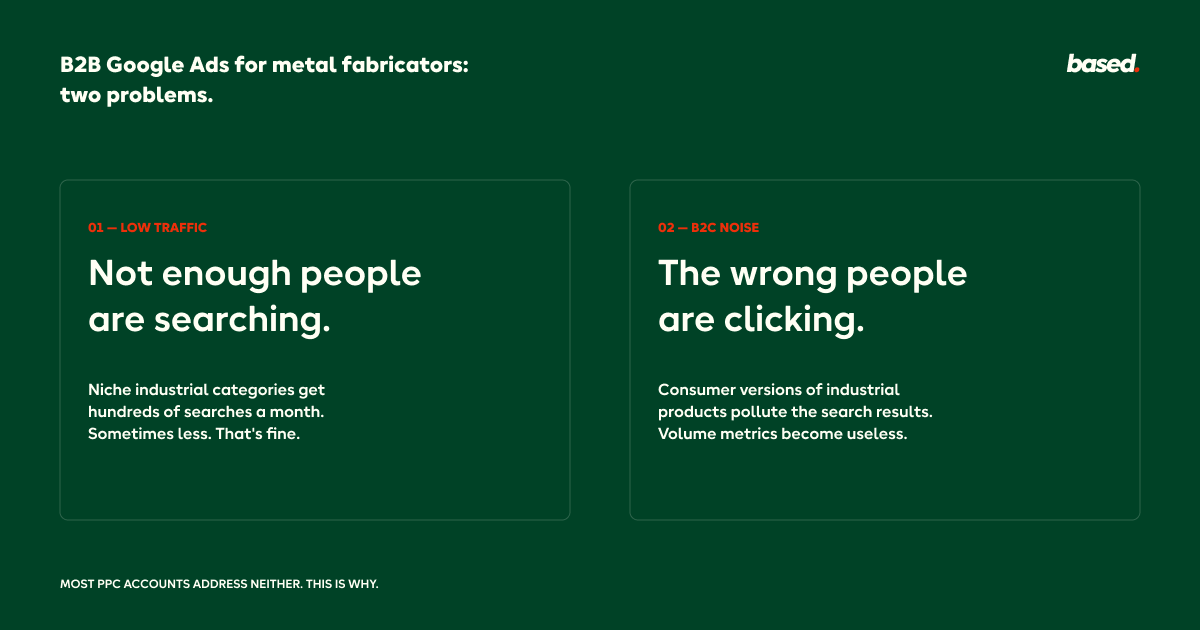
There's a moment in almost every PPC audit for a metal fabricator where a junior account manager looks at the search volume data and says some version of "this is a problem." The keywords they're bidding on — custom sheet metal enclosures, CNC bending services, AS9100 certified welding — get a few hundred searches a month nationally. Sometimes less. The Google Ads interface turns the numbers red. It flags low search volume. It suggests expanding your match types.
Don't.
The instinct that drives this — the instinct to fix low traffic by creating more of it — is the performance marketing reflex applied to a context where it doesn't belong. It's the same reflex that turned a generation of B2B marketers into slaves to impression share and CTR benchmarks that have no relationship to whether their clients are winning contracts.
Metal fabrication isn't a high-volume search category. It never will be. There are only so many procurement managers at aerospace OEMs searching for precision sheet metal sub-assemblies in a given month, and most of them aren't on Google when they're doing it — they're on Approved Vendor Lists, or in a plant manager's contacts, or following up on a reference. The buyers who do search are the exception. They matter enormously. But the solution to reaching them is not to dilute your targeting until you're also reaching maintenance engineers in Ohio who want to make a custom bracket for their home workshop.
One qualified lead in metal fabrication is worth more than most marketing teams understand. A new account with an industrial OEM — one that buys consistently over two or three years — can represent seven figures in revenue. Running PPC to get more impressions and cheaper clicks is not the job. The job is to not miss the handful of people who are actually searching for exactly what your client does, and to not waste money on everyone else.
This requires a different way of running the account.
Start tight and stay tight
The standard advice from Google — and from agencies that bill on media spend — is to launch broad, gather data, then optimise. “Spend more” in other words. This is advice that is good for Google and bad for metal fabricators. Broad targeting in a B2B niche with mixed search intent is not a data-gathering exercise. It's a way to burn budget on B2C traffic, train the algorithm on the wrong signals, and end up with a CRM full of homeowners who wanted a custom gate.
Start with exact match. Keep geographic targeting to the realistic service area. Run search network only, not display, not Performance Max. The search volume will look alarming. It won't be.
The metrics that matter in this context are not what the default dashboard shows. Forget average position, forget impression share. Track three things: the number of form submissions that contain actual project specifications, the number of those that become quotes, and the number of quotes that close. Everything else is noise.
Position-based bidding makes sense here. You want your ads at the top of the page for the few relevant searches that exist. The competition in most fabrication niches isn't fierce enough to make top-of-page bids prohibitive, and the downside of missing a searcher in a low-volume category — because your ad appeared below the fold and they clicked a competitor — is disproportionately high relative to the difference in cost.
There's a related tactic worth knowing for fabricators whose target terms have near-zero search volume: advertise adjacent to the real search. A company that makes precision enclosures for industrial control systems might find that nobody searches for that. But engineers search for DIN rail components, or panel board accessories, or cable management systems — things that go inside the enclosures they're trying to source. Running ads against those terms gets the fabricator in front of the right people, even if the search isn't a direct match.
The same logic applies when a fabricator is entering a new vertical. If your client is pitching aerospace for the first time and has no organic presence, the buyers researching suppliers in that sector aren't searching for your client by name. But they are searching for AS9100 welding, or tight-tolerance aluminum components, or NADCAP-compliant machining. Being visible there — consistently, with useful ad copy — is how you get into the consideration set before the formal RFQ process starts.
The B2C contamination problem
Some metal fabricators don't have a volume problem. They have the opposite one: their search terms attract consumer traffic. Dust extraction systems, custom metal shelving, steel gates, even some welding services — all of these have consumer markets that generate far more search volume than the B2B buyers buried within them.
The standard response to this is a list of negative keywords. DIY. Home. Hobby. Residential. This helps, but not as much as people want it to. Most B2C searchers don't announce themselves. A homeowner searching for a custom steel gate doesn't type "residential custom steel gate." They type the same thing a property developer searching for ten of them would type.
There are better filters. Running ads only during business hours removes a meaningful chunk of consumer traffic, because most people doing B2C shopping on Google aren't doing it at 10am on a Tuesday. Device targeting — showing ads on desktops and laptops only, not mobile — filters out the casual browser. Ad copy is a filter too. "Minimum order quantities apply." "Commercial projects only." "Quoting for 50+ units." These lines don't just describe the business — they actively discourage the wrong clicks before they happen.
None of these are perfect. Each one also filters out some legitimate B2B buyers: the plant manager doing research at home on a Saturday, the engineer with a tablet on the factory floor. The goal is not a perfectly clean account. The goal is an account where the ratio of valuable leads to wasted spend is high enough to justify the channel. In most metal fabrication categories, that's achievable with a combination of match type discipline, schedule, device settings, and deliberate ad copy.
The lever your competition doesn't use
Here's where most PPC accounts for industrial clients stay permanently amateur: they optimise for form submissions and call the job done.
Form submissions in B2B manufacturing are not a useful optimisation signal. A significant percentage of them are bad: wrong industry, wrong scale, a single custom part for someone's side project. Training Google's algorithm to get more of them is training it to get more of the wrong thing.
The right signal is a qualified lead — one that's been reviewed by a real human, confirmed as a viable project, and passed to sales. Google can optimise toward that signal, but only if you tell it which leads are qualified. This is what offline conversion imports are for.
The mechanic is not complicated. When a form submission comes in and someone at the company determines it's worth quoting, that decision gets logged in a CRM, which sends a conversion signal back to Google Ads with a time stamp that matches the original click. Google learns to find more people who behave the way this person behaved before they submitted. Over time — and it does take time, and it does require enough volume of qualified leads to train on — the algorithm shifts. The account gets smarter in a way that media spend alone can never achieve.
Most agencies don't set this up because it requires coordination with the client's sales team and CRM, and that's inconvenient. Most clients don't push for it because they don't know it exists. The ones who do it have a structural advantage in every auction they enter.
What Google can't do, and where LinkedIn fills the gap
Google search captures demand. It reaches people who are already in the market, already searching. For metal fabricators with a specific target customer profile — aerospace procurement managers, or medical device OEMs, or food processing equipment manufacturers — there's a meaningful audience that never searches at all. They already have suppliers. They're not dissatisfied enough to go looking. But they'd switch if the right company got in front of them at the right moment.
This is a demand creation problem. Google doesn't solve it. LinkedIn does.
The targeting on LinkedIn is genuinely useful for industrial B2B in a way it isn't for most consumer categories. You can reach people by job title, company size, and industry simultaneously. Procurement managers at industrial manufacturers with 500+ employees in the Midlands. Process engineers at pharmaceutical companies in the northeast. The audience size will be small. That's fine. Impression-level reach isn't the goal. The goal is to exist in the peripheral awareness of the people who, in six months, might have a project.
What you show them matters. The instinct is to advertise services and capabilities. This is a mistake. Nobody on LinkedIn wants to be sold to, and nobody at a company that already has fabrication suppliers is going to switch based on a banner ad listing your certifications.
Promote something useful. A guide on design for fabrication tolerances. A case study on a project that solved a specific engineering problem. A technical explainer on material selection for a particular application. The value exchange is: useful information in exchange for attention and recall. When the moment arrives — when there is a project, when the current supplier fails, when the contract comes up for re-tender — you want to already be a name they associate with knowing what they're talking about.
The sales cycle math that changes everything
Metal fabrication has long sales cycles. A new customer acquisition takes three to four months at minimum. Complex custom projects take six to nine. Enterprise contracts can take eighteen months from first contact to signed paper.
This breaks most PPC reporting entirely.
If you're looking at last-click attribution in a thirty-day window, PPC for metal fabrication will always look like it doesn't work. The click that eventually leads to a closed deal happened months before the deal closed. The form submission sat in a sales pipeline for a quarter before anyone called it won or lost. Standard campaign reporting doesn't show this.
The fix is not to find a magic attribution model. It's to build a longer view into how the client evaluates the channel. Track the pipeline — what came in, what got quoted, what closed — and connect it back to the original source. Accept that the feedback loop is slow and plan for it. Set expectations that a PPC campaign for a fabricator isn't going to show ROI in ninety days. It might not show it in six months. What it shows in six months is whether the leads coming in are worth quoting. The revenue evidence comes later.
This is really icky for clients who want to see returns quickly and uncomfortable for agencies whose value is easier to demonstrate with dashboards than with twelve-month pipeline analysis. It's also the accurate picture of what PPC can and can't do in a category with long purchase cycles.
The obscurity tax in metal fabrication is real. Companies that don't appear in search results for the small number of relevant queries in their category don't get the meeting. They don't get the quote. The account that goes into the buyer's shortlist is the account that was visible when the buyer was looking. In a low-volume search environment, "visible when the buyer is looking" doesn't require scale. It requires presence — consistent, tight, well-targeted presence at the top of a small number of very specific searches.
That's a solvable problem. The mistake is treating it like a volume problem instead.