
How to Build a Media Plan for a Product Launch (5 Steps)
Friends, let's be honest - most of our media plans for launches are built backwards. Someone picks the channels first (the ones they're comfortable with, the ones the team already has logins for, the ones that won last time), then writes a rationale to justify the selection. The strategy follows the spreadsheet instead of the other way around. The result is a plan that looks considered but was actually assembled by inertia and vendor relationships.
This is the companion piece to why most product launches fail. That article covers the strategic pillars. This one covers the media plan — the document where the strategy either gets funded properly or gets diluted into a channel list that serves nobody.
In this article
- Decide what the launch needs to do — demand creation vs. capture
- Pick channels by function, not familiarity
- Sequence the spend — don't spray it
- Set budgets by threshold, not by "what's left"
- Build measurement into the plan, not after it
- The plan on one page
Step 1: Decide what the launch needs to do — demand creation vs. demand capture
Every launch has two jobs. Create new demand and capture existing demand. These are not the same job. They require different channels, different creative, different measurement, and different timelines. Most media plans fail because they fund one job and expect it to do both.
Demand creation is making people who weren't thinking about your category — or weren't thinking about you — start. This is the fame work. Brand video. Audio. OOH. Creator partnerships where the creator actually says something instead of holding your product next to their face. Sponsorships that put you in a context the audience already cares about. This is how you build the mental availability that makes everything else cheaper later.
Demand capture is converting people who are already in-market. Paid search. Shopping ads. Retargeting. Performance social. Bottom-funnel work that only exists because someone, somewhere, at some point, did the demand creation that put you on the list.
The ratio between these two depends on exactly one thing: how well-known you already are. If you're launching a new product from an established brand with high existing awareness, you can weight toward capture — people already know you, they just need to know about the new thing. If you're launching into a market where nobody knows your name, and you put 80% into capture, you are fishing in a pond that doesn't have your fish in it yet.
For most launches from brands that aren't household names — which is most brands — the split should favor creation. 60/40. 70/30. Whatever your CFO can stomach. The performance budget converts the demand the brand budget creates. Without the brand budget, the performance budget is just bidding against everyone else for the same thin slice of existing intent.
Decision: Write down your demand creation / demand capture ratio and the reasoning behind it. If you can't justify the split with a sentence about your current awareness level, it's probably defaulting to whatever you did last time.
Step 2: Pick channels by function, not by familiarity
Channels are tools. You pick tools based on what needs doing, not based on which ones you used last time. A hammer is great. Not for screws.
Here's a functional taxonomy that's more useful than any media agency's proprietary channel planning framework:
If you're measuring reach builders by last-click conversions, you are measuring a hammer by how well it drives screws and then concluding that hammers don't work.
Pick from each category based on the demand creation / demand capture split you decided in Step 1. A launch plan with zero reach builders is a promotion. A launch plan with zero converters is a brand campaign that can't prove ROI. You need both. The question is the ratio, and the ratio comes from how known you are before you start. This is exactly what our media team builds for every client engagement.
Decision: Map every channel in your plan to one of these four functions. If you can't explain what job a channel is doing, it's in the plan because of inertia, not strategy.
Step 3: Sequence the spend — don't spray it
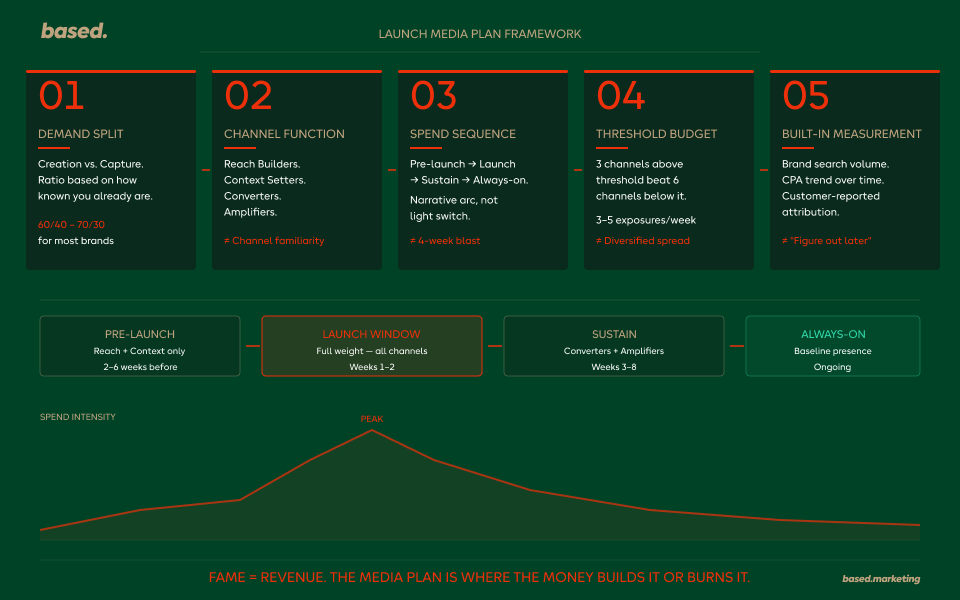
Media plans are not just about where. They're about when. And the default "flight everything at the same time for four weeks" approach is one of the most reliable ways to waste a launch budget, wave bye-bye to those $50k you fought so hard to get.
Pre-launch (2–6 weeks before)
Reach builders and context setters only. No conversion channels. You're not selling yet. You're making deposits into mental availability so that when you do start selling, the audience isn't meeting you for the first time. This is the phase most brands skip entirely because it doesn't generate trackable revenue, which is exactly why their launch day feels like cold outreach to a million strangers.
Launch window (weeks 1–2)
Full weight. Reach builders sustain, converters activate. This is the heaviest spend period and the only window where everything runs simultaneously. The reach work you did pre-launch means your conversion channels now reach people with some existing familiarity instead of zero. That familiarity is why your CPAs will be lower than if you'd just turned everything on at once.
Sustain (weeks 3–8)
This is where most brands go dark and then wonder why the launch "lost momentum." There was no momentum — there was a media plan that ended. Sustain means pulling back reach builders to maintenance frequency, keeping converters active, and shifting budget toward amplifiers — boosting the creative that performed, redistributing toward the channels that over-indexed.
Post-launch (ongoing)
What does always-on look like after the launch spend ends? If the answer is "nothing until the next campaign," you are building sandcastles. The plan should account for this transition. This is where the obscurity tax either starts compounding or starts declining.
Decision: The media plan should be shaped like a narrative arc, not like a light switch. Memory works through repetition over time, not through volume in a single moment. A twelve-week sequence builds an association. A four-week blast builds a spike.
Step 4: Set budgets by minimum effective threshold — not by "what's left"
The most common budgeting approach: total budget gets divided across channels based on historical allocation percentages, gut feeling, and whatever the most persuasive vendor pitched in Q4. Nobody asks whether the budget allocated to any single channel is actually enough to do anything there.
There is a minimum effective spend for every channel. Below that threshold, you are visible but not memorable — you made impressions that nobody will recall because the frequency was too low to build an association. You showed up at the party, said hello to nobody, and left.
The threshold question for every channel: At this budget level, can we reach our target audience at a frequency that creates memory? If the answer is no, don't spend less there. Spend zero there and reallocate to a channel where the budget is above threshold.
This is counterintuitive and it's why most media plans are bad. People spread budget across channels to feel diversified. What they're actually doing is ensuring that every channel is underfunded. Three channels above threshold will outperform six channels below it, every time, because three channels that create memory beat six channels that create impressions nobody retains.
Rough frequency benchmarks: for brand-building media (video, audio, OOH), you need somewhere around 3–5 exposures per person per week during active flight to start building memory. For performance channels, frequency matters less because you're capturing existing intent — but creative fatigue matters more, which means you need enough budget for variant testing and rotation.
If the total launch budget doesn't support above-threshold spend on at least one reach builder and one converter, the budget isn't big enough for a launch. It's big enough for a promotion. Plan accordingly and call it what it is. We covered why this distinction matters in Pillar 4 of the product launch framework.
Decision: For every channel in the plan, answer: "Is this funded above the minimum effective threshold?" If not, kill it and reallocate. Underfunded channels don't contribute — they waste money while making the spreadsheet look diversified.
Step 5: Build the measurement into the plan — not after it
The media plan and the measurement plan are the same document. If you're building the media plan now and planning to "figure out measurement later," you will measure whatever is easiest to measure, which means you will measure conversions, which means you will conclude that only the conversion channels worked, which means next time you will allocate more to conversion and less to brand, which means your launch will perform worse. This is the death spiral. It has a name. It's called the obscurity tax, and it compounds.
Pre-launch measurement
Brand search volume (baseline), aided and unaided awareness (survey if budget allows), social listening volume. You're establishing the "before" so you can prove the "after." It's easier to do in based.planner.
Launch window measurement
All of the above plus conversion metrics. Watch for the leading indicator that matters most: did brand search volume increase? If you're creating fame, people start Googling you by name. If they're not, your reach builders aren't working or your creative isn't landing. This is attribution-agnostic measurement in practice.
Sustain measurement
CPA trend over time. This is the proof. If your brand work is building fame, your performance channels get cheaper week over week. If your CPAs are flat or rising during sustain, the brand work isn't translating and you need to diagnose why — creative, targeting, frequency, or the product itself.
Post-launch measurement
Repeat purchase rate from launch cohorts. Customer-reported attribution ("how did you hear about us" — one free text field, worth more than your entire attribution stack). Cost to acquire in months 2–6 versus month 1.
Decision
None of this is exotic. All of it is ignored by most launch media plans because the plan was built by a media team optimizing for channel metrics while the brand team wasn't in the room. The media plan should be built by the people accountable for the business outcome, with the media team executing the buy. Not the other way around.
The plan on one page
If your launch media plan can't be summarized on a single page with clear answers to these five questions, it's not a plan — it's a spreadsheet that grew sentient and started making decisions.
Five decisions that make a launch media plan
- What's the demand creation / demand capture split and why? — based on your current awareness level, not historical allocation
- Which channels serve which function? — reach builders, context setters, converters, amplifiers — not "channels we're present on"
- What's the sequence? — Pre-launch → Launch → Sustain → Always-on, not "everything at once for four weeks"
- Is every channel funded above the minimum effective threshold? — if not, kill it and reallocate
- What are we measuring at each phase? — to know if it's working before the sales data arrives
The brands that build media plans this way don't just launch better. They get better at launching, because they're measuring the inputs that predict outcomes instead of the outcomes that already happened. Each launch starts from a higher floor than the last one. That's what compound fame looks like in a spreadsheet: declining acquisition costs, rising baseline awareness, and a CFO who stops asking why you're spending money on things that don't convert in-session.
See how we applied this approach for Kensa's media strategy and Directly Digital's 360° campaign.
Fame = Revenue. The media plan is where the money either builds it or burns it.