
What's stopping manufacturing brands from growth?
Swap the logos. Nobody notices.
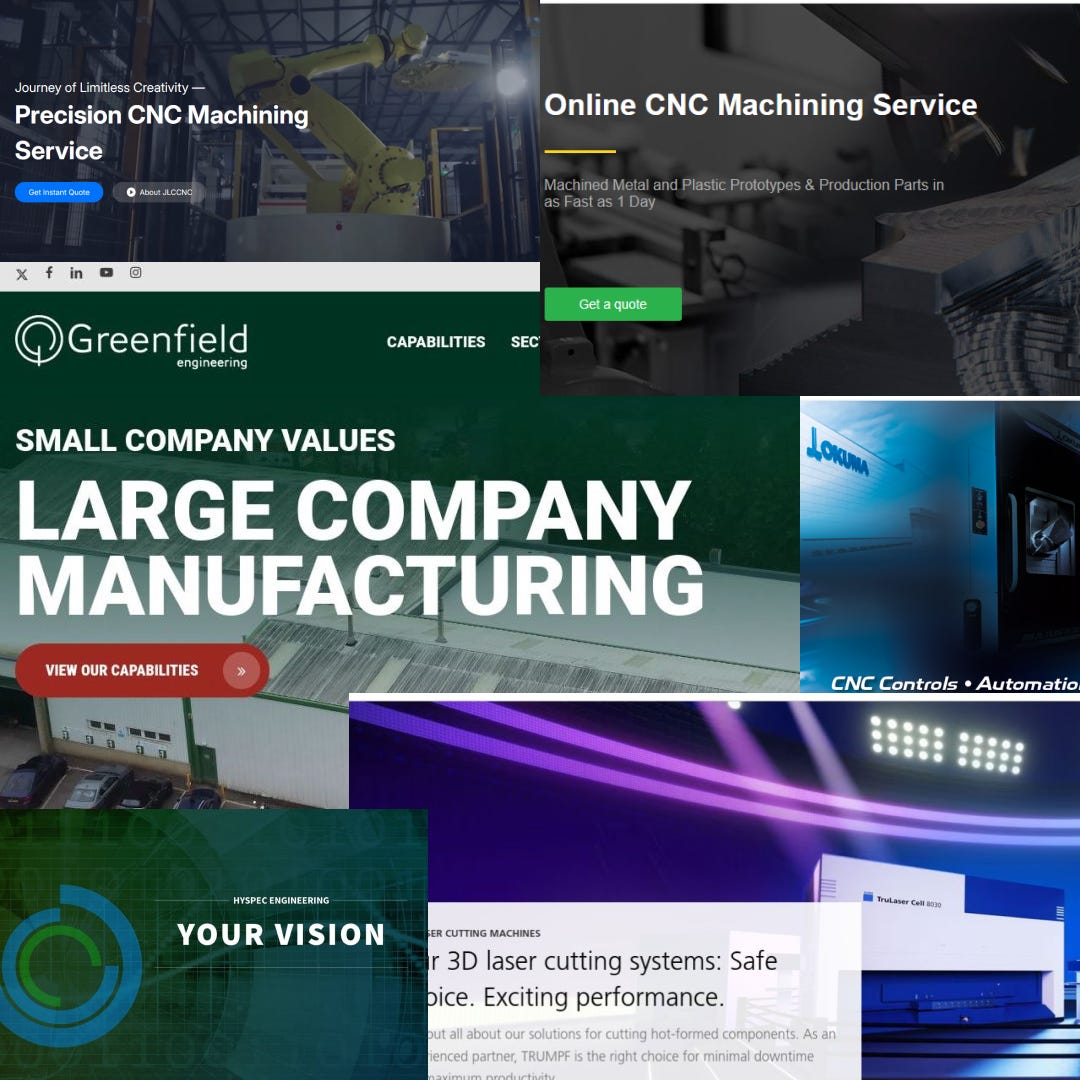
Open twenty CNC machining websites. Any twenty. You’ll see the same thing. Blue sparks. Orange sparks. A machine hero shot. “Precision. Quality. Innovation.” Sometimes in a different order, because apparently that counts as strategy now. Dark blue. Grey. White. Sans-serif logo. Stock photo of a man in a hard hat staring at a clipboard like it owes him money.
Then the About page:
“Founded in 1987, we are committed to delivering high-quality solutions to our valued customers.” Imagine: somebody briefed that sentence, read it, approved it, and paid for it. Now swap the logos between two of those companies. Leave them swapped for a week.
I’ll bet you nobody notices.
Not the customers. Not the sales team. Probably not even the owner whose surname is on the building. Hell, you won’t notice — not if you forget you did it.
Manufacturing got a brand problem. And it has nothing to do with quality.
Most of these companies are good. Some are excellent. They hold tolerances their competitors can’t. They hit dates. They have operators who have been running the same Mazak for fifteen years and can hear a problem before the spindle knows it has one.
Does any of it show up before the quote stage? Of course not. So the buyer sees five tabs that look identical. The market reads that as: ordinary.
The grid
Put fifteen manufacturing homepages next to each other.
The sameness stops being an opinion and becomes evidence.
Same sparks.
Same three words.
Same “solutions.”
Same man with crossed arms in front of a machine that could belong to any company, in any industrial park, in any country with grey weather and ISO certificates. Which is to say: Poland, the UK, Germany, Sweden.
Individually, each website is fine.
Clean enough. Loads fast. Mobile responsive. Nothing obviously broken. It would be fantastic if you were the only manufacturing company in the world. But you’re out of luck — buyers don’t evaluate one supplier in isolation. I once stood behind Malgorzata, a procurement specialist, as she worked through a shortlist a production manager had handed her.
Opens six tabs. Looks for a bit. Leaves to check testimonials and reviews. And in those six tabs, usually nothing to remember.
No voice. No specific claim. No actual people. No point of view. No reason to think “ok, these are the ones.”
You can be the best shop in the region with a negligible error rate and still lose, because your website looks like the other five tabs Malgorzata has open while eating a salad at her desk. But we’re not selling a website redesign here. Your brand nightmare doesn’t stop at the website.
Trade show booth?
Same gradient banner. Same three words at eye level. Same bowl of branded mints. Same rep in a quarter-zip waiting for someone to make eye contact.
LinkedIn?
Same “proud to announce” posts. Same drone shot of the building. Same machine-running-at-night video with no caption worth reading.
The sameness is not a design problem. It’s indecision, fear, and inertia. It’s the anxiety of doing the thing no one else dares to do. Made again and again. Why do it?
Why everyone does it
Manufacturing people are not lazy. The industry runs on people showing up at 6am and fixing problems that would make a marketing department — not to mention an agency like based. — cry into Notion. The sameness comes from fear. Three fears, mostly.
The first one:
“Our customers don’t care about the brand.”
BUZZZ. Wrong.
Your customer is a purchasing manager named Dave with a boss, a quota, and a mortgage. Dave makes an emotional decision first:
“Who do I trust not to mess this up and get me yelled at?”
Then he builds an RFQ process around that decision so it looks rational. The supplier already in Dave’s head has an advantage before pricing even starts. That warm, fuzzy feeling is brand. And you, in all your wisdom and experience, just decided not to compete for it.
Second fear:
“We’ll look unprofessional.”
In manufacturing, “professional” usually means “indistinguishable from competitors.” A bolder color feels risky. A direct voice feels risky. Photos of your actual people instead of the stock clipboard hostage feel risky. So everyone runs back to the same safe visual language.
But safe is not safe. Safe is invisible. And invisible is expensive. System1 analysed 55,000+ ads against IPA effectiveness data and found dull creative needs 2.6x the media spend to achieve the same market share growth. Dull feels responsible because dull is measurable. Then you pay for it later, in media spend, margin pressure, and sales calls where the only thing the buyer remembers is the lowest price.
Third fear:
“We compete on capabilities, not marketing.”
Same with marketing agencies — if we relied on free Google Ads certifications and partnership status to bring us business, we’d close up shop inside a month.
The problem with standards and certifications is that they’re standards. Everyone should have them. ISO 9001. AS9100. Five-axis. Wire EDM. Tight tolerances. Short lead times. Decades of experience. You got them, so you list them. So do the other five tabs. Capabilities get you considered. They do not get you remembered. That’s the bit everyone skips.
Agencies helped create this mess
Every agency that sold manufacturing companies the same blue-grey-white template should take some of the blame.
Sparks. Three-word tagline. Stock operator. “Solutions.” Ship the website. Ship it yesterday. Send the invoice. Nobody gets fired. God, please, no one gets fired. That template is safe to sell.
Even I am partly responsible, because in previous agencies I’ve done exactly that. That was par for the course for old agency work to sell this stuff.
It is not safe to buy. It protects the agency from a difficult conversation — from building a strategy and a comms plan, from doing the SEO, the content, the messaging, and all the other hard marketing things.
It does not protect the client from becoming interchangeable.
Worth remembering whose risk is actually being reduced.
Distinctive does not mean stupid
This is where manufacturing companies panic.
They hear “stand out” and imagine a clown nose on a CNC machine.
No. (But also — maybe?)
Distinctive does not mean unserious. It means your buyer can cover the logo and still know it’s you. Different photography, different language, different proof — a different way of showing the work. Be as technical and credible as before. Just not dead on arrival.
We once built a campaign for a sheet-metal laser-cutter manufacturer around the line:
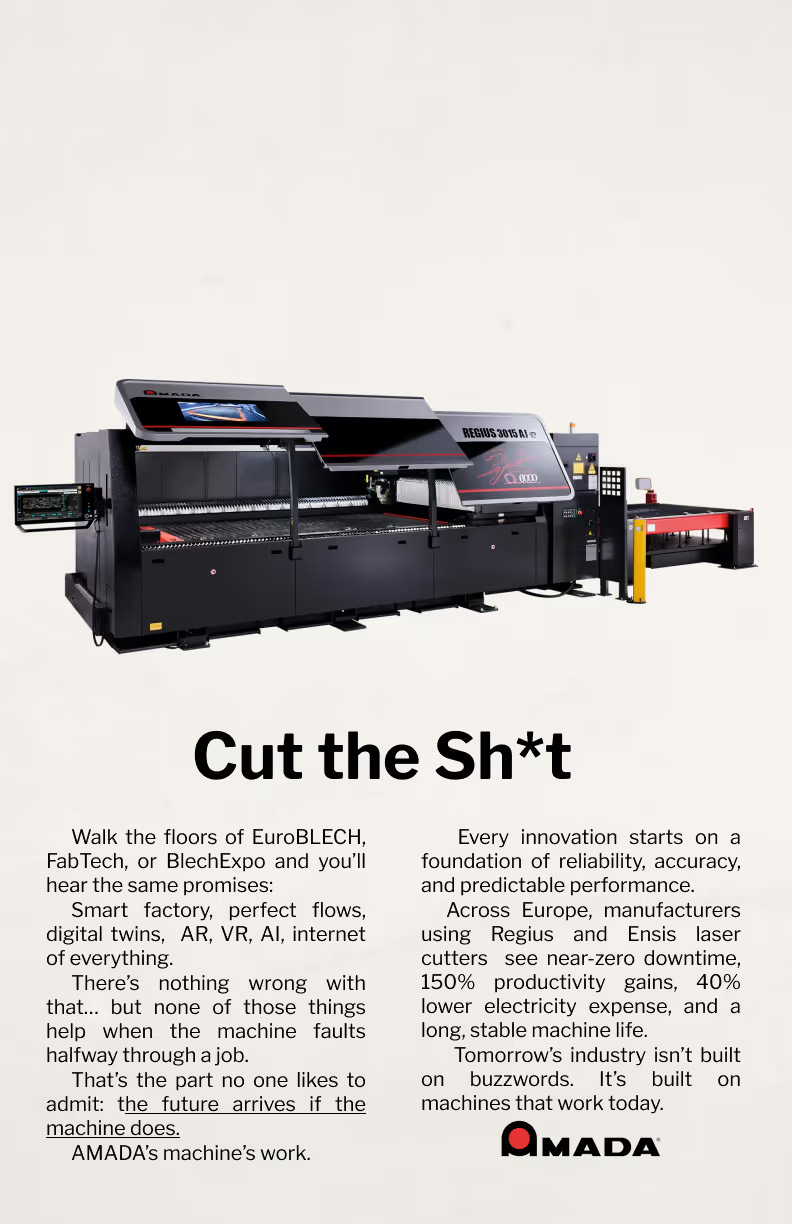
“Cut the Sh*t.”
When we pitched it in person, the room got nervous. Of course it did. The industry standard is pretending nobody on a shop floor has ever sworn near a machine. But the line worked because it said what the buyer already felt. The specs were still there. The product was still serious. The campaign was just also impossible to confuse with everyone else’s “precision solutions for tomorrow.” That is the job.
Kongsberg (and now their new company Falkor) does this well at the serious end of the market. Two hundred years of Norwegian industrial heritage, but the brand still manages to look like it believes it has a future — not another supplier hiding behind a navy gradient and a PDF called “Innovation Brochure Final v7.”
Haas is the obvious example. Say “Haas” in a shop and people know what you mean. They built a name machinists actually say, then put it on a Formula 1 car, because someone in manufacturing finally remembered that being known is useful. Wild concept.
DMG Mori does the quieter version. You walk into one of their stands and you know where you are before you read the sign. Color. Lighting. Typography. Machine staging. It holds together.
Most industrial companies can’t keep their brand consistent across two PowerPoint slides.
Test it now. Cover your logo. If what’s left could belong to any competitor, you don’t have a brand. You have a ThemeForest template.
The real cost
When every supplier looks the same, the buyer defaults to the only variable left.
Price.
Congratulations.
You volunteered for the race to the bottom and handed your competitors the starting gun. Now manufacturing runs on the rules of a discount supermarket.
Let’s go back to Dave, sitting somewhere in Gary, Indiana. Dave needs a part.
He opens three CNC suppliers.
Same certs, same claims, same photos. Same “quality solutions” and “Manufacturing your ideas!” He has no reason to prefer one. So he asks all three for a quote and squeezes the cheapest.
Now run it again.
One supplier is already in his head. Their booth was the one he remembered. Their LinkedIn posts didn’t read like they were written by a machine guarding a compliance manual. Their website showed actual operators, actual parts, actual problems they solve. Their founder had a point of view, and the people he’d provoked were arguing with him in the comments. Dave shortlists them first. The others become benchmarks. Here you go, that is precisely the financial effect of brand in manufacturing.
Not “awareness,” the polite word for wasting money.
Straight-up business preference. Good brand is nepotism you can buy: it walks you to the front of the line and into rooms no one else can enter.
So you’re either the preferred supplier or the price anchor. Not much middle ground. Plenty of excellent manufacturers are already being used as price anchors for worse competitors with better memory structures.
Same quality of work. Maybe better. But because the market doesn’t remember them, they get dragged into quote comparisons they should be leading. Then comes the invisible marketing IRS, here to collect the obscurity tax. It won’t show up as a line item, so nobody fights it.
But you pay it constantly. In deals that never reach you. In quotes you only win by cutting margin. In sales cycles where the buyer feels nothing when they see your name. In paid-search budgets trying to buy demand you never created. And this is where the performance-marketing crowd goes quiet. Dashboards are great at counting the last thing that happened. They’re terrible at explaining why Dave searched for you in the first place.
Analytic Partners found last-click attribution overstates paid-search impact by 190% and undervalues brand-building by 90%. The easy-to-measure stuff takes the credit for the hard-to-build stuff.
You starve the thing that creates preference, then overpay to capture the demand once it already exists.
Very efficient. Congratulations again.
The boring template only captures demand
The safe manufacturing website does exactly one job.
Someone types “5-axis machining near me” or “laser cutting supplier Sweden,” and maybe you show up.
That’s demand capture. Useful, sure.
It’s also a knife fight in a parking lot. Everyone wants the same buyer at the same moment. Everyone has the same claims. Everyone is one quote away from being discarded.
You can bring another knife. You can show up unarmed. Or you can roll in on a gold-plated M1 Abrams.
The tank is being the name the buyer already brings into the search. The supplier they trust before the RFQ exists. The company they mention internally before procurement turns the whole thing into spreadsheet theater.
Sameness locks you into capture. Brand gets you into the buyer’s head before the spreadsheet exists.
Your machine shop might genuinely do better work than half the market. But the market will never find out if every visible part of your company says:
“We are basically like the others, but please ask us for a quote.”
Cover your logo. Cover your name.
Look at what’s left.
Then be honest. Do you have a brand?