
You have 200 years of credibility that marketing can't convert into revenue
That's not a product problem. Your engineers already solved their part. It's the gap between what's better and what gets bought — and most deep tech companies try to close it with a whitepaper and a conference stand.
based. supports DeepTech companies - from legacy to stayups to startups, with effective marketing strategy, creative production, media buying, and data & analytics services that so far led to $32M+ in deals.




.png)

Fame=Revenue, especially when selling something so futuristic that it sounds made up
It's hard to become efficient at marketing. It is harder (but fun!) to become effective.
Now picture this: You became the name your buyers trust.
Wait, don't let the imagination run too far, we are not Coca Cola-famous everywhere. Not Adidas-recognizable. At least not in the beginning.
Famous enough where it matters. Known by the buyers you need. Widely-recognised in the category you play in. Easier to choose because your brand already did part of the selling before the first form fill, demo request, product page visit, or sales call.
That is what effective marketing does.It does not just chase existing demand around the internet with retargeting ads and a nervous discount.
It creates future demand. It makes your brand easier to notice, easier to remember, easier to find, and easier to buy from. That is the work of effective, fame-building marketing.
That's what we do.


AMADA - 80 years of metal processing, and a campaign that said "Cut the Sh*t"
After 80 years in business, AMADA is in the top of metal processing equipment manufacturers in Europe, with a rich legacy, broad offering, loyal customers, and cutting-edge technology. They needed.
To retain its market position and grow the business we needed to find ways to stand out, announce the brand while respectfully acknowledging almost a century of AMADA’s history.


Kongsberg Digital — $32M in PoC deals for a 200-year-old company selling the future
Kongsberg has been part of Norwegian industry since before ships were made of anything but wood. That legacy beats any competitor on trust and works against you the moment you try to sell digital twin software to drilling engineers, fleet managers and energy grid operators. The creative angle was space-positivism — Star Trek, not spreadsheets — which is how you get attention from a C-suite buried in identical vendor decks. Campaigns led to $32M in proof of concept deals with Shell, BP, and Skanska.
We build marketing that people actually remember
360° Marketing Strategy
We help you solve complex business problems through honest, big-picture marketing strategies that lead to fame and revenue.
Creative & Production
Ads people skip cost more than the ads people remember. We make the kind that gets remembered. Including Creative strategy, Campaigns, Copywriting and Art direction.

Media & Automation
Great creative no one sees is just expensive art. Fame requires reach - real reach, at the frequency where memory gets built.

Measurement & Analytics
Everything important will be measured. We give you proof your CFO can't argue with—and insights your competitors don't have.
Start with the audit
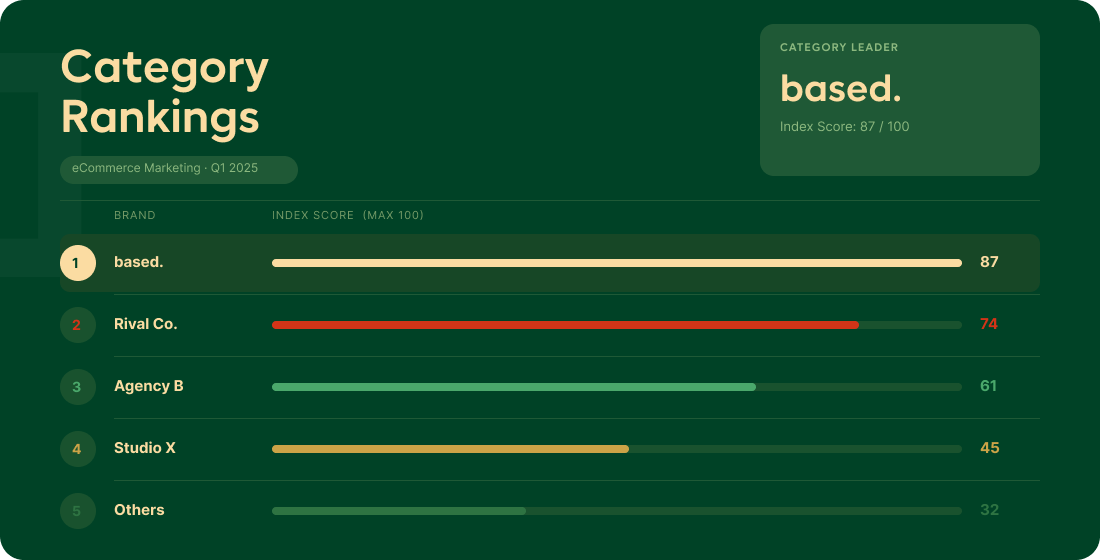
Category and market standing
Output:
Category read
Main competitors
Market position
Category conventions
Differentiation gaps
Visibility opportunities
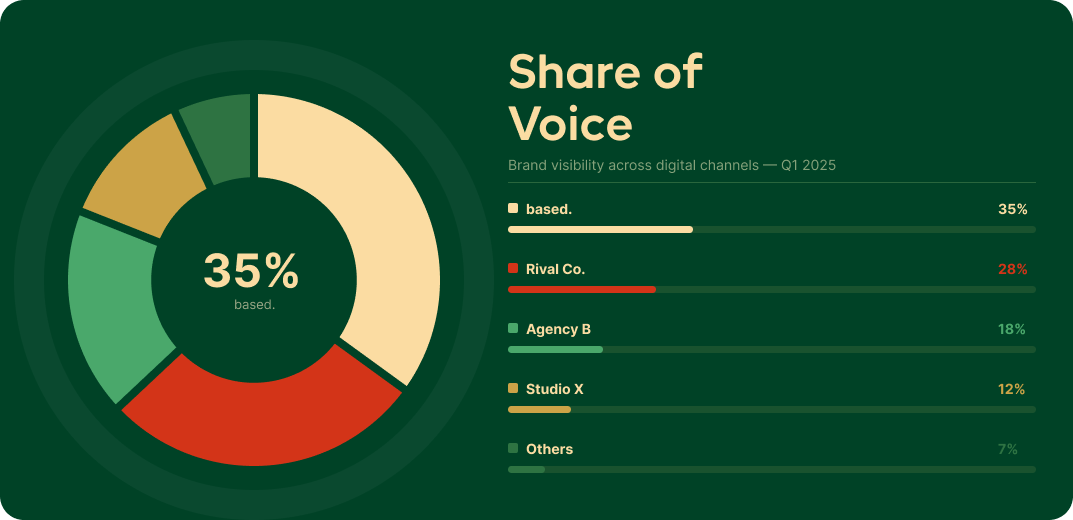
Share of voice and attention
Output:
Paid visibility read
Competitor media presence
Search demand signals
Social visibility
Retargeting vs acquisition balance
Underused channels
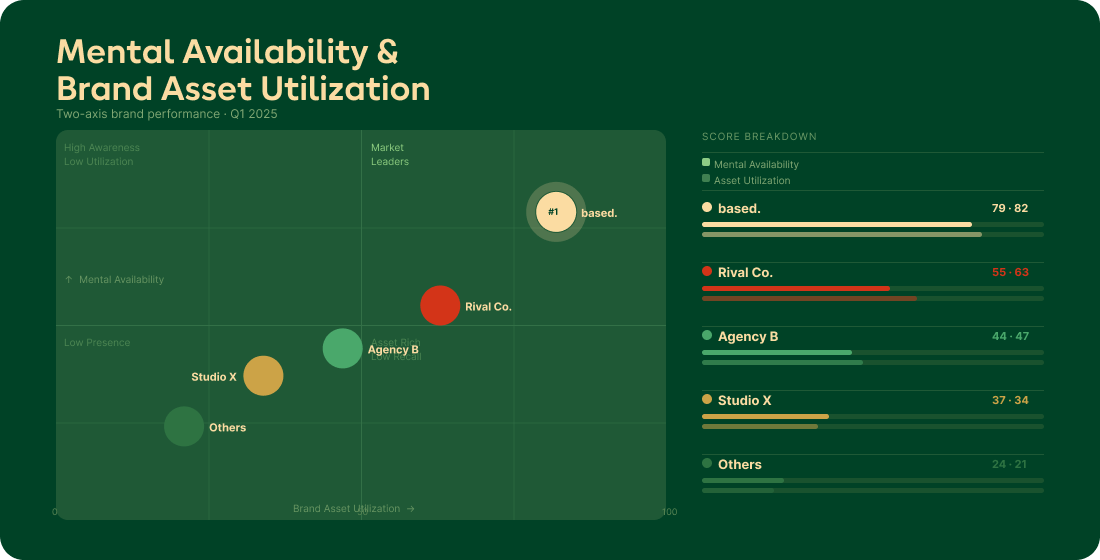
Mental availability & Distinctive brand assets utilization
Output:
Category entry point review
Buying triggers
Message-market fit
Brand recall risks
Demand creation gaps

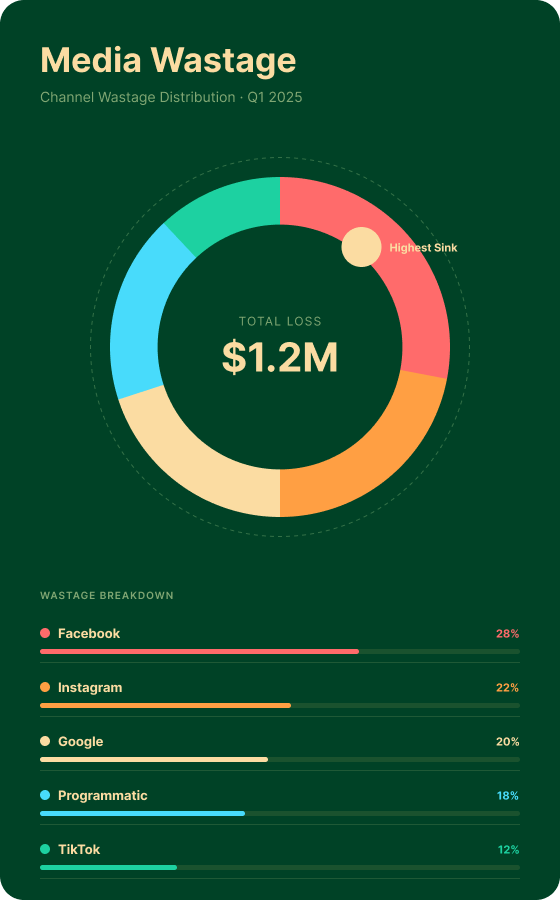
Media wastage & performance drains
Output:
Channel mix review
Prospecting vs retargeting balance
Brand vs non-brand search split
Warm audience dependency
Duplicated attribution
Budget leakage points
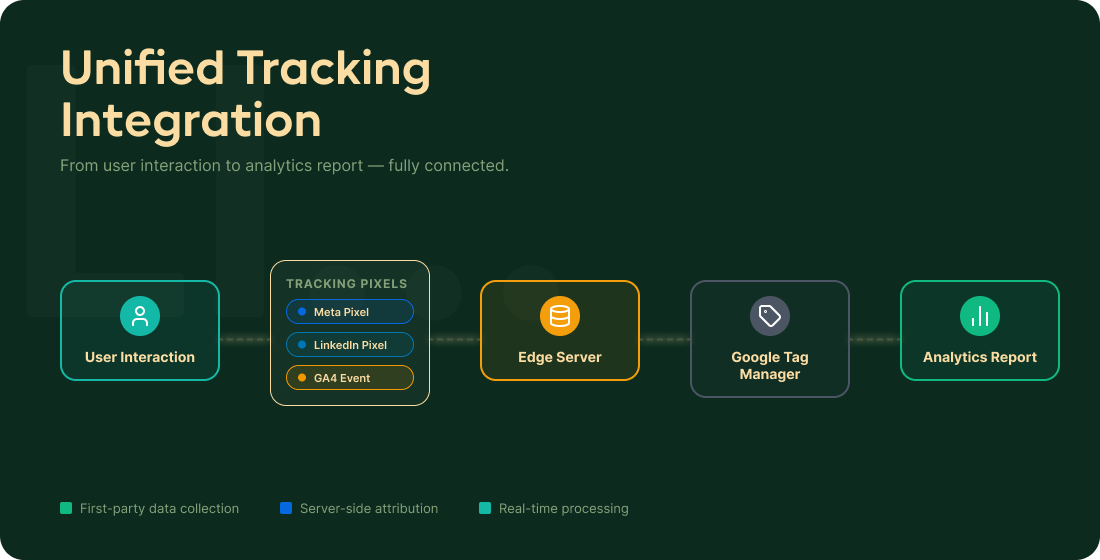
Tracking and commercial truth
Output:
GA4 review
Platform conversion setup
CRM / HubSpot / Shopify / Klaviyo connections
Attribution inflation risks
Blended performance view
Decision-ready metric recommendations
What you get
A structured report covering market standing, competitors, share of voice, creative memorability, distinctive assets, media wastage, tracking issues and priority recommendations.
We walk you through the findings, explain what matters, what is noise and what should be fixed first.


You get a clear list of what to fix first, what to stop doing and what needs proper strategy instead of another campaign tweak.
Who is this for?
Industrial software and digital twin
Robotics and automation
Semiconductors and photonics
Advanced materials
Precision manufacturing equipment
Sensors and instrumentation
Maritime and offshore technology
Aerospace and defence technology
.svg)

.svg)
Don't just take our word for it

...before you click "submit"
"We've been burned by agencies before."
"How do you even measure all of this?"
Our ongoing agency work starts from €2,000/month or 10% of media spend, whichever is higher.
If that feels insane, we are not the right agency.
If it feels reasonable because your current marketing waste is probably higher than that, the audit is a good place to start.
Find out what "invisible" costs you
Don't trust Mark Zuckerberg to tell you it is working. Don't rely on Google taking credit. Don't even trust the dashboard looking squeaky-clean.
Keep paying the tax, or choose to see the bill. Because we take only 4 new requests each month - our audit is free, and we'll tell you straight whether fame is even your problem. If it isn't, we'll tell you that too.
Got questions?
We got answers
It's an agency that can sell a technology the market doesn't have a word for yet. That means three jobs most agencies don't do: naming and building the category so the thing you sell has somewhere to live in a buyer's head, making technical credibility legible to the non-technical people on the committee, and sustaining all of it across a sales cycle measured in years rather than quarters. The channels are ordinary — search, LinkedIn, programmatic, DOOH, TV. The argument is not.
SaaS marketing assumes the category already exists and competes inside it on features, price and speed. Deep tech usually has no category, no budget line and no comparison set — your competition is the buyer doing nothing for another two years. SaaS can also run a free trial and let the product sell itself. You can't trial a digital twin or a fiber laser. Everything has to be carried by the marketing before anyone touches the product.
Not much, and the two get used interchangeably. Hard tech usually implies physical engineering — hardware, materials, manufacturing. Deep tech is broader and covers anything built on a scientific or engineering advance that took years to make work, including software like digital twin. If you're arguing about which one you are, you're probably both, and the marketing problem is identical either way.
Established companies. We're good at a specific problem: an industrial business with decades of credibility trying to sell something its market finds hard to believe. Kongsberg had been part of Norwegian industry since before ships were made of anything but wood, and needed to sell digital twin software to drilling engineers and grid operators. AMADA has 80 years in metal processing equipment. That legacy is your biggest asset and your biggest obstacle at the same time.
You build the category before you sell into it. For Kongsberg the angle was space-positivism — Star Trek rather than spreadsheets — which is how you get attention from a C-suite reading identical vendor decks all week. Account-based communications went to the named accounts that mattered, and long-term brand work built recognition across everyone else, so that when procurement finally wrote a line item, it had our client's shape in it. Over two years that produced 852 qualified leads and more than $32M in proof-of-concept deals.
Not with last-click, thank God! Analytic Partners found last-click overestimates paid search by 190% and undervalues brand building by 90%, so the default dashboard argues against the work that compounds. We report on qualified leads your sales team actually accepts, movement in prompted and unprompted awareness, cost per qualified lead over time, and pipeline attributable to campaigns. On Kongsberg that showed up as a 39% brand lift and a 75% decrease in cost per lead.
Longer than you want and shorter than the sales cycle. Performance work moves in weeks. Category and brand work moves in quarters, and the Kongsberg programme ran across two years before the full picture was visible. If someone promises you a measurable brand lift by next quarter in a category with a two-year buying cycle, they're selling you the small share of buyers who were already looking.
Industrial software and digital twin, robotics and automation, semiconductors and photonics, advanced materials, precision manufacturing equipment, sensors and instrumentation, maritime and offshore technology, aerospace and defence technology, and energy systems and grid technology.
The common thread is a technical buying committee, a conservative market, and a product that needs explaining before it can be compared.