
Effective Marketing for Cleantech & Renewables
It has been better for years. Cheaper to run, cleaner, cheaper over the life of the building.
A homeowner in Sheffield replaces a broken gas boiler with another gas boiler. Why? because that's the thing they've heard of and the installer down the road already knows how to fit it.
That gap — between what's better and what gets bought — is not an engineering problem. Your engineers already solved their part. It's a marketing problem, and most cleantech companies are trying to solve it with a lead-gen funnel and a webinar.
We work in categories where being right isn't enough.



.png)

Cleantech is different,
but not in the ways people say
Everyone selling to this sector will tell you the sales cycles are long and the buyers are technical. True, and not useful. Here's what actually changes the work:
You're selling against inertia, not competitors. Your real competition is the thing already installed, the supplier the procurement team used last time, and the decision to do nothing for another eighteen months. Nobody runs a comparison page against "doing nothing."
Your buying committee doesn't share a language. For Kensa we mapped four audiences who all had to say yes: council members, homeowners, municipal officials and neighbourhood associations. A message that lands with a homeowner worried about their bill is not the message that moves a council procurement officer. Most cleantech media plans run one message at all four and wonder why the cost per lead climbs.
Policy moves your market overnight. A subsidy changes and your addressable market doubles or evaporates. Brands that are already famous when that happens capture the shift. Brands still building awareness spend the whole window explaining who they are.
The category is conservative and cost-driven. Buyers in this sector are not early adopters. They're risk managers. Every purchase is a bet on a technology their board has questions about.
Fame=Revenue, especially when four people have to say "yes" and one of them is a council
.svg)
The 95:5 problem with energy
At any moment about 5% of your buyers are in market.
The other 95% aren't buying a heat pump, a grid management platform or 40MW of storage this quarter, and no amount of retargeting changes that.
Most cleantech marketing budgets speak only to the 5%. That's the part you can measure this quarter, so that's the part that gets funded.
It's worse in the energy transition, because your replacement cycles run in decades. A commercial boiler gets replaced once every twenty years.
If you only exist in the buyer's mind during the eight weeks they're actively shopping, you have to win a coin flip against an incumbent they already trust.
If you're famous before the boiler breaks, you're not in the comparison — you're the reason they started looking.Last-click attribution overestimates paid search by 190% and undervalues brand building by 90%, according to Analytic Partners. System1 found it takes 2.6x more media spend to hit the same market share growth when the creative is dull.
Dull is safe, because dull is measurable.

Kensa — making a heat pump brand famous during a heating crisis
Kensa is the UK's #1 ground source heat pump provider. Ground source is the most cost-effective and sustainable way to heat homes, schools, commercial buildings and whole neighbourhoods. We audited the strategy, positioning and spend, ran market and audience research, and rebuilt the media plan around separate messages for each of the four audiences who had to agree. We positioned the purchase as a warm hug that lasts decades.

Kongsberg Digital — $32M in PoC deals for a 200-year-old company selling the future
Kongsberg has been part of Norwegian industry since before ships were made of anything but wood. That legacy beats any competitor on trust and works against you the moment you try to sell digital twin software to drilling engineers, fleet managers and energy grid operators. The creative angle was space-positivism — Star Trek, not spreadsheets — which is how you get attention from a C-suite buried in identical vendor decks. Campaigns led to $32M in proof of concept deals with Shell, BP, and Skanska.
Don't just take our word for it

We build effective cleantech marketing
360° Marketing Strategy
We help you solve complex business problems through honest, big-picture marketing strategies that lead to fame and revenue.
Creative & Production
Ads people skip cost more than the ads people remember. We make the kind that gets remembered. Including Creative strategy, Campaigns, Copywriting and Art direction.

Media & Automation
Great creative no one sees is just expensive art. Fame requires reach - real reach, at the frequency where memory gets built.

Measurement & Analytics
Everything important will be measured. We give you proof your CFO can't argue with—and insights your competitors don't have.
Start with the audit
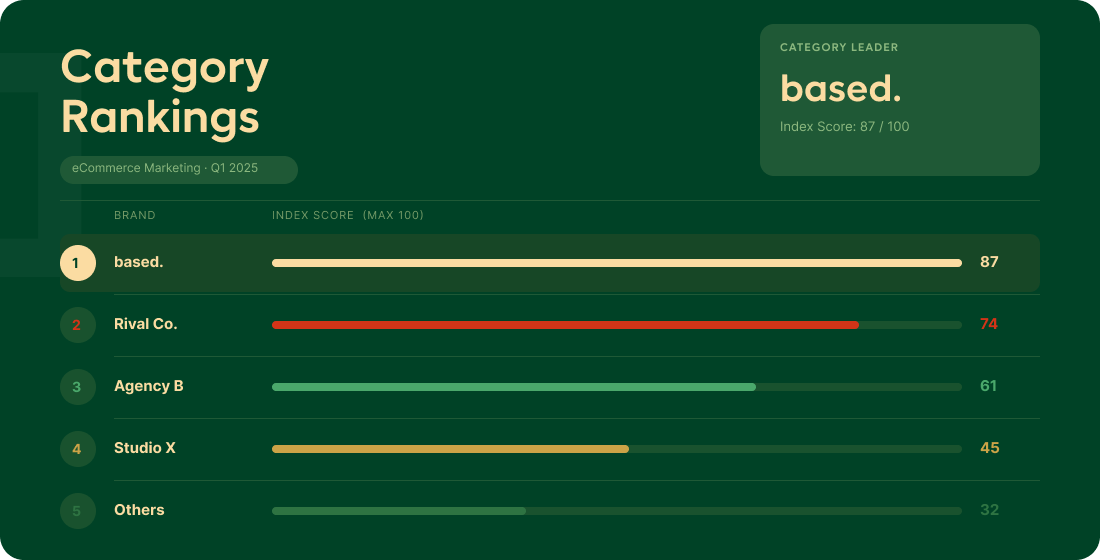
Category and market standing
Output:
Category read
Main competitors
Market position
Category conventions
Differentiation gaps
Visibility opportunities
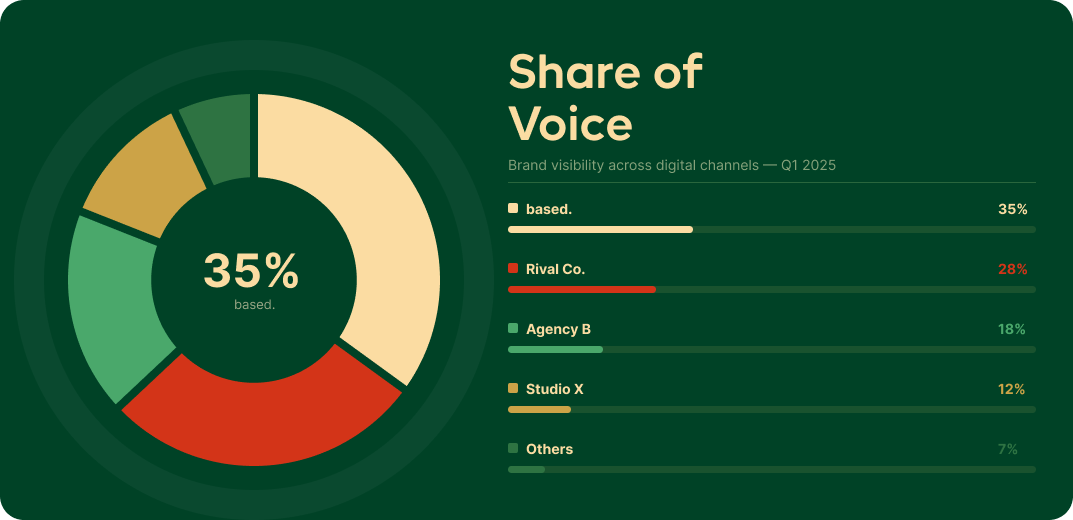
Share of voice and attention
Output:
Paid visibility read
Competitor media presence
Search demand signals
Social visibility
Retargeting vs acquisition balance
Underused channels
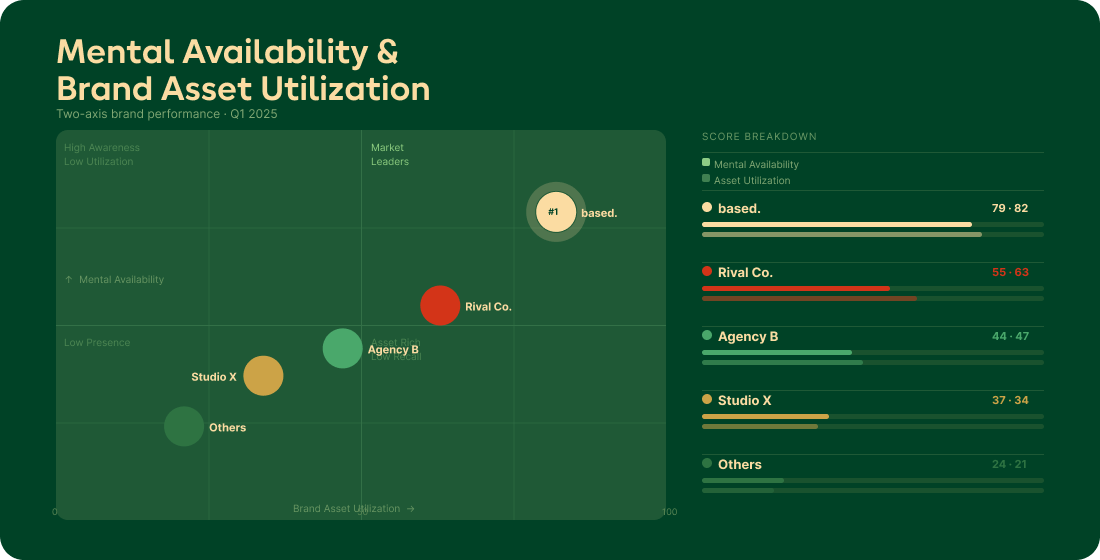
Mental availability & Distinctive brand assets utilization
Output:
Category entry point review
Buying triggers
Message-market fit
Brand recall risks
Demand creation gaps

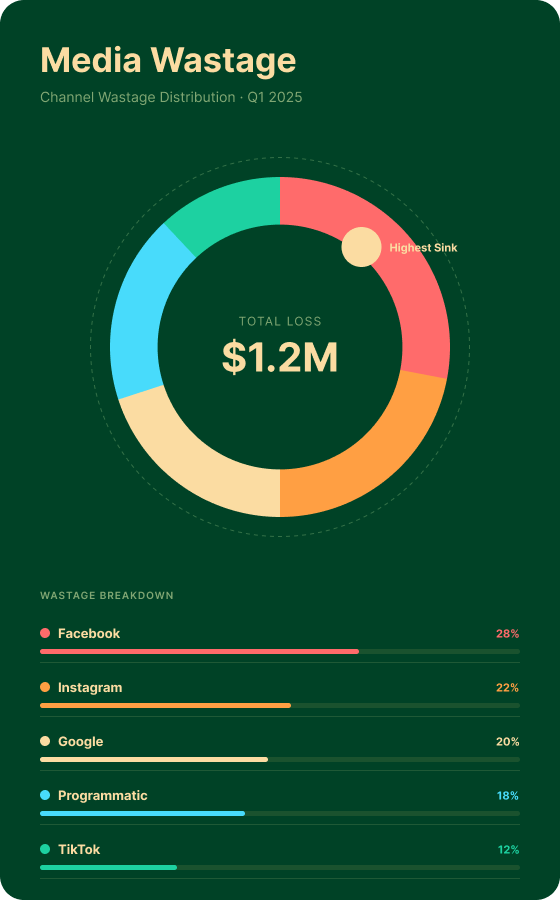
Media wastage & performance drains
Output:
Channel mix review
Prospecting vs retargeting balance
Brand vs non-brand search split
Warm audience dependency
Duplicated attribution
Budget leakage points
Tracking and commercial truth
Output:
GA4 review
Platform conversion setup
CRM / HubSpot / Shopify / Klaviyo connections
Attribution inflation risks
Blended performance view
Decision-ready metric recommendations
What you get
A structured report covering market standing, competitors, share of voice, creative memorability, distinctive assets, media wastage, tracking issues and priority recommendations.
We walk you through the findings, explain what matters, what is noise and what should be fixed first.


You get a clear list of what to fix first, what to stop doing and what needs proper strategy instead of another campaign tweak.
Who we do this for
Cleantech SaaS
Ground source and air source heat pump manufacturers
Sustainable Materials & Manufacturing
Green Buildings & Construction
Renewable energy developers
Battery and grid-scale storage
Solar and wind supply chain
Decarbonisation and carbon accounting platforms
.svg)

.svg)
...before you click "submit"
"We've been burned by agencies before."
"How do you even measure all of this?"
Our ongoing agency work starts from €2,000/month or 10% of media spend, whichever is higher.
If that feels insane, we are not the right agency.
If it feels reasonable because your current marketing waste is probably higher than that, the audit is a good place to start.
Find out what "invisible" costs you
Don't trust Mark Zuckerberg to tell you it is working. Don't rely on Google taking credit. Don't even trust the dashboard looking squeaky-clean.
Keep paying the tax, or choose to see the bill. Because we take only 4 new requests each month - our audit is free, and we'll tell you straight whether fame is even your problem. If it isn't, we'll tell you that too.
Got questions?
We got answers
It makes a better technology the one people have actually heard of. In cleantech that means two jobs at once: reaching the small share of buyers in market this quarter, and building recognition with the much larger share who will buy in three years. The work covers positioning, message architecture for each audience in the buying committee, media planning and buying across search, programmatic, LinkedIn, DOOH and TV, and measurement built around qualified leads and brand lift rather than form fills.
Three things change the work. You are selling against inertia rather than a competitor, because the real alternative is the equipment already installed and the decision to do nothing for another eighteen months. Your buying committee does not share a language: for Kensa we mapped council members, homeowners, municipal officials and neighbourhood associations, all of whom had to agree. And policy moves your market overnight, so a subsidy change can double or erase your addressable market before a campaign finishes flighting.
Being compared on price because nobody asked for you by name. Losing at the last mile to an installer who fits what they always fit. Spending a six-month subsidy window explaining what your technology is instead of selling it. And starting every sales conversation from zero, with the sales team explaining the category, the technology and why the incumbent is wrong. These are all symptoms of the same problem, which is that the market does not know who you are before it needs you.
No. We work across industrial, manufacturing and B2B tech. Cleantech and renewables is where a lot of the work has landed, because the gap between "better product" and "market leader" is widest here.
Lead gen works the 5% who are in market now. We do that too, but the reason your cost per lead keeps climbing is that you're fishing in the same small pool as everyone else. The fix is upstream.
With brand lift studies, share of voice tracking and qualified lead quality, not last-click attribution. Analytic Partners found that last-click overestimates the impact of paid search by 190 percent while undervaluing brand building by 90 percent, so the default dashboard will always argue against the work that compounds. We report on the leads sales actually accepts, movement in prompted and unprompted awareness, and cost per qualified lead over time.
Performance moves in weeks. Brand moves in quarters. Kongsberg was a three-year campaign. Anyone promising a brand lift by Q3 is selling you the 5% again.
Look at the revenue and spend bands on the form. If you're under €10k a month in media, the audit is probably the right starting point, not a retainer.
The team is across Europe.